Pwnable tw realloc
源码分析
菜单类题目,一共三个选择: alloc, realloc, free,其中我们就是利用了 realloc 中的漏洞点。
realloc 调用了 realloc(ptr, size, content) 这个函数,这个函数显而易见就是用来重新分配某块内存的。
- 如果
size == 0,那么很显然就是把原来的块free掉。 - 如果
size < oldsize,那么就是把剩下的块free掉。 -
如果
size > oldsize,那么就要先malloc(size),然后把原来的块free掉。
但是这里有个特殊情况:如果这个原来块后面就紧接着 top chunk,那么很显然只要从 top chunk 割一点分给它就好了,不需要上述操作 -
如果
size == oldsize,那么就保持不变,就是把块里面数据改成content即可。
上面这个还是比较直观的,仔细体会。本题就是没有判断是否 realloc(0),所以可以造成 Double Free. 总体结构如下.
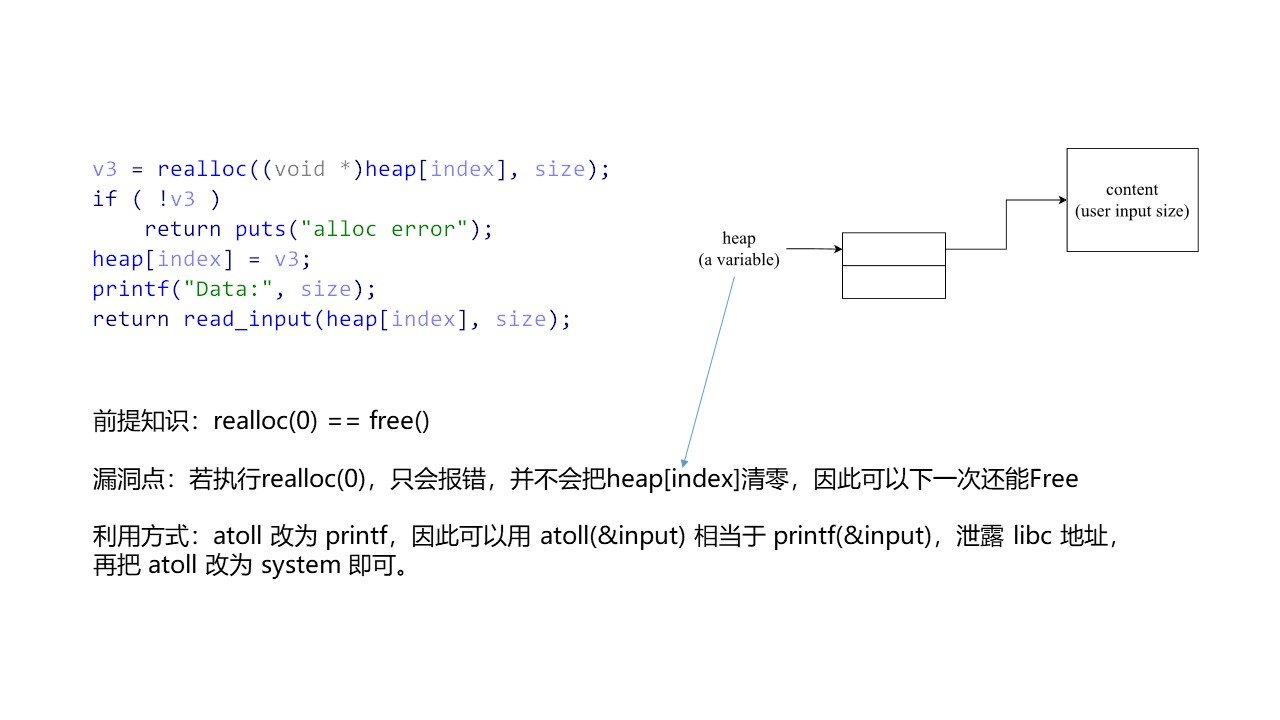
利用步骤
步骤一:统揽全局
在这直接说出本题的目标,算是一个该学到的姿势: 把 atoll 改成 printf 泄露,再改成 system 攻击。我知道很玄乎,看下面的步骤吧。
步骤二:atoll to printf
第一步:atoll_got 放入 tcache bin 中
这个太简单了,就是 double free 即可,看下面的代码。对了,程序一共可以申请两个指针,比如 my_alloc(0, ..) 就是关于第一个指针的事。
# 假定这个块为 node[0]
my_alloc(0, 0x18, 'AAAA')
# tcache[0x18]: node[0]
my_realloc(0, 0, '')
# tcache[0x18]: node[0] -> atoll_got
my_realloc(0, 0x18, p64(atoll_got))
# tcache[0x18]: atoll_got
# heap[0] == heap[1] == node[0]
my_alloc(1, 0x18, 'BBBB')
第二步:free 不去污染 atoll_got 所在链表
下面我们还要继续利用这两个指针,所以要把他们先 my_free 掉,其中 my_free 函数会把当前指针清零。
否则在 alloc 中,程序发现它不是 0,就会提前终止。
现在的 atoll_got 在 tcache[0x18] 这个链表首部。堆里面只有一个 [0x18] 大小的块,ptr0 和 ptr1 都是指向它,设为 node[0]。
如果我们就是简单地 my_free(0),那么很显然 tcache[0x18] 结构就会被破坏掉,所以要另辟蹊径。
- 对于
ptr0而言。
我们先 my_realloc(0, 0x28, 'AAAA'),可以想象现在 realloc 是什么样的行为?是不是先 malloc 再 free,大错特错!
因为 node[0] 后面就紧挨着 top chunk,所以系统是直接从 top chunk 割一点给 node[0] 即可!
所以这样 node[0] 大小就为 0x28 了,此时调用 my_free(0),那么 node[0] 就乖乖在 tcache[0x28] 那个链表中去了。
- 对于
ptr1而言。
如果我们效仿 ptr0 会怎么样?要知道 ptr1 也是指向 node[0],所以这样同样会让 node[0] 放入 tcache[0x28],系统就检测到 Double Free 了。
所以我们要破坏系统的检测,系统检测 tcache 有没有 Double Free 是通过下面的 key 来进行检测的。
typedef struct tcache_entry
{
  struct tcache_entry *next;
  struct tcache_perthread_struct *key; // 通过这个字段进行判断是否 Double Free
} tcache_entr
那么我们就这样: my_alloc(1, 0x28, 'DDDDDDDDDDD'),这样会让 node[0] 的 key 变成 DDDD,那么很显然再放入 tcache 中就不会检测到 Doube Free 了。
下面是这一步的代码
my_realloc(0, 0x28, 'CCCC')
my_free(0)
my_realloc(1, 0x28, 'DDDDDDDDDDDDDDDD')
my_free(1)
第三步:atoll 变为 printf
然后就直接通过 my_alloc(0, 0x38, p64(print_plt)) 就可以了。
但是呢,这一步最好放到最后再去做。(看脚本就知道了)
步骤三:atoll to system
效仿步骤二即可。
步骤四:总体步骤
- 首先将
atoll放入tcache[0x18]和tcache[0x38]中去。 - 将
atoll变为printf,程序调用atoll(&input),相当于printf(&input),这就可以格式化字符串攻击,最终可以得到system地址。 - 将
atoll变为system,程序调用atoll(&input),就可以system(&input)。注意这一步中atoll是printf,printf返回值是输入长度,比如需要my_alloc(1, 0x18, 'AAAA'),那么就要改成my_alloc('a', 'a'*0x18, 'aaaa')。